 Listicle
5 Shock Absorbing Mats for Cheerleading Compared
Quick Summary
The five best shock absorbing mats for cheerleading are the Tumbl Trak Gymnastic Tumbling Mat, the Tumbl Trak Pit Pillow, the Flooring Inc. Stand-Alone Cheer and Tumbling Mat, the Greatmats Folding Gym Mat and the Greatmats Crash Pad. Each suits a different job, from tumbling practice to high-impact stunt landings.
- Flooring Inc. describes its stand-alone cheer and tumbling mats as 8 to 12 inches thick.
- Tumbling-oriented mats generally run in the 2-inch range, giving cushioning without making the surface too soft to push off.
- Thicker is not automatically better, since a very soft mat can make it harder for a base or flyer to hold position.
- Check whether a listed thickness refers to the foam core alone or the finished mat including the surface layer.
- Measure your floor space and confirm seams stay closed, since roll-out and folding mats can creep or separate.
Table of Contents
- How We Chose These Five Shock Absorbing Mats
- Cheer Mat Thickness and Shock Absorption: What Actually Matters
- 1. Tumbl Trak Gymnastic Tumbling Mat
- 2. Tumbl Trak Pit Pillow
- 3. Flooring Inc. Stand-Alone Cheer and Tumbling Mat
- 4. Greatmats Folding Gym Mat for Stunting Practice
- 5. Greatmats Crash Pad for Stunt-Heavy Teams
- Choosing the Right Mat for Your Team and Space
- Frequently Asked Questions
5 Shock Absorbing Mats for Cheerleading Compared
Last Updated: November 12, 2026
How We Chose These Five Shock Absorbing Mats
Choosing a shock absorbing mat for cheerleading comes down to three things: how well it cushions landings, how stable it stays under load, and whether it fits the space and the athletes using it. This comparison is intended to help coaches, gym owners and parents narrow the field. The five products below were selected from the catalogs and product listings available for cheer and tumbling mats.
Quick Picks:
- Best for tumbling practice: Tumbl Trak Gymnastic Tumbling Mat
- Best for landing protection: Tumbl Trak Pit Pillow
- Best for a thick stand-alone option: Flooring Inc. Stand-Alone Cheer and Tumbling Mat
- Best for stunt practice on a budget: Greatmats Folding Gym Mat
- Best for high-impact stunting: Greatmats Crash Pad
Shock absorption is the headline feature for all five, but the listings do not always publish the same specifications. Where a dimension, thickness or test result was not supplied, this comparison says so rather than filling the gap with an estimate.
Cheer Mat Thickness and Shock Absorption: What Actually Matters
A thicker mat is not automatically a better mat. Thickness adds cushioning for high-impact landings, but foam density, the core material and the surface layer all affect how the mat feels underfoot and how stable it is when a stunt lands. U.S. Consumer Product Safety Commission guidance on home gym and fitness equipment safety is a useful starting point for reviewing general safety considerations before buying any landing surface.
For cheer practice, the main trade-off is between cushioning and stability. A very soft, deep mat absorbs more impact but can make it harder for a base or flyer to hold a position. A thinner, firmer mat gives a steadier platform for stunts but cushions less during falls.
Foam type and construction
Most cheer and tumbling mats use one of three core constructions. Common core constructions include polyethylene foam, polyurethane foam, bonded or cross-linked foam, carpet-bonded surfaces and vinyl-coated roll-out mats. Each trades off firmness, resilience, grip and portability differently, so compare the construction a listing describes.
Thickness and firmness by activity
A common pattern in cheer mat catalogs is to separate products by intended activity rather than by a single thickness number. Read this explainer on how spring floor shock absorption is tested to standards for more on how these figures are measured. Tumbling and skill-progression mats tend to run in the 2-inch range, which gives enough cushioning for passes without making the surface too soft to push off. Stunt and partner-work surfaces are usually firmer and may be thinner, because bases need a stable platform to plant and lift from. Landing and crash products are much thicker and are designed to catch a fall from height rather than to be walked or tumbled on.
What to compare before buying
Rather than relying on a single cushioning claim, compare five practical criteria side by side: foam type and density, finished thickness, surface grip and texture, coverage area, and the activity the manufacturer names for the product. Ask for the density figure in pounds per cubic foot if it is not published, and check whether the mat is rated for stunting or only for tumbling. A mat that cushions well but slides under a base is a worse choice for stunts than a firmer mat that stays put.
A very thick, soft mat can feel comfortable but may become unstable under a flyer's landing, so test the surface under load before committing a team to it.
The table below summarises the main construction and activity categories described in this section.
| Category | Typical use | Key trade-off |
|---|---|---|
| Tumbling and skill-progression mats | Passes and skill progression | Cushioning vs. push-off firmness |
| Stunt and partner-work surfaces | Bases planting and lifting | Stability vs. cushioning |
| Landing and crash products | Falls from height | Very thick, not for walking or tumbling |
| Foam core types | Shock absorption and grip | Firmness, resilience, grip and portability differ |
1. Tumbl Trak Gymnastic Tumbling Mat
The Tumbl Trak Gymnastic Tumbling Mat is listed in the company's cheer mats and flooring category. It is a tumbling-oriented product, suited to teams that spend most of their practice time on passes and skill progression rather than stunts alone.
The listing does not provide dimensions, thickness or specific shock-absorption figures, so buyers should request those details from the seller before ordering. Its strongest point is its placement within a dedicated cheer and tumbling catalog, which makes it easier to find matching accessories.
Best for: teams focused on tumbling and skill progression. Skip if: you need published thickness or impact-test data before buying.
2. Tumbl Trak Pit Pillow
The Tumbl Trak Pit Pillow is a specialized landing product, also listed in the cheer mats and flooring category. It serves a different role from a floor mat: it is designed to catch falls from height rather than cover a full practice area.
The supplied information does not state dimensions, construction or the intended skill level. That makes it harder to judge fit for a specific gym, so measure the available space and confirm the product's specifications before purchase.
Best for: teams that need a dedicated landing area for dismounts and stunt falls. Skip if: your practice space has no room for a separate landing product.
3. Flooring Inc. Stand-Alone Cheer and Tumbling Mat
Flooring Inc. describes its stand-alone cheer and tumbling mats as 8 to 12 inches thick and markets them for absorbing landing impact.
The listing does not identify the exact model behind the starting price, so confirm which configuration matches the quoted rate. The thickness range is one of the more concrete specifications in this comparison, which makes it a practical choice for buyers who want substantial cushioning under a stand-alone format.
Best for: buyers wanting thick, stand-alone cushioning for landings. Skip if: you need a mat thinner than 8 inches for stability during stunts.
4. Greatmats Folding Gym Mat for Stunting Practice
The Greatmats folding gym mat is described as suitable for gymnastics training, cheerleading stunting and physical education. Its foam core is described as providing cushioning and shock absorption, and the folding format makes storage simpler in shared gyms.
The supplied results do not give dimensions, thickness or pricing. Before buying, confirm the thickness and core density, since those determine how much cushioning the mat provides under stunt landings.
Best for: stunt practice where folding storage matters. Skip if: you need published thickness or impact data to meet a facility requirement.
5. Greatmats Crash Pad for Stunt-Heavy Teams
Greatmats presents its crash pad as a thick mat with a large coverage area, recommended for cheerleading that involves stunting.
Exact dimensions, thickness measurements and pricing were not included in the supplied results. Because coverage area affects how many athletes can practice at once, measure your floor and request the exact coverage size before buying.
Best for: stunt-heavy teams that need broad coverage and thick cushioning. Skip if: your space is too small to accommodate a large pad.
Choosing the Right Mat for Your Team and Space
The right mat depends on what your team does most often. Tumbling-heavy programs should prioritize cushioning and surface comfort. Stunt-focused teams need a stable, grippy surface with enough coverage for bases and flyers. Shared gyms should weigh storage, since a folding mat or roll-out option can be moved out of the way between sessions.
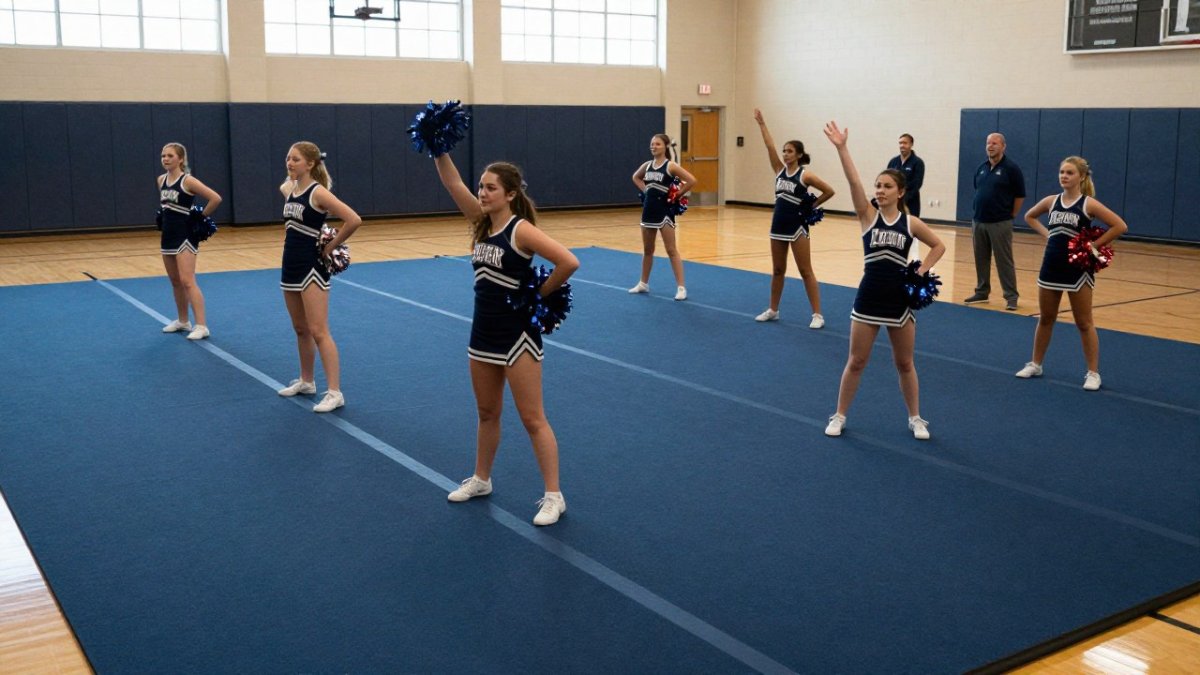
Measure the space before you shop
Start with three measurements: the floor area you can dedicate, the ceiling height if you plan to use a landing product, and the number of athletes practicing at once. Then compare thickness, coverage and surface type against those numbers. Where a listing is missing a specification, ask the seller directly rather than assuming. For a stand-alone mat, allow clearance around the edges so athletes do not land half on and half off the surface. If you plan to connect multiple mats, confirm that the edges are designed to join and that the combined surface stays level at the seams.
Check for gaps and movement during use
A common pattern is for roll-out and folding mats to creep or separate at the seams after repeated stunting. Before each session, check that seams are closed, that the mat is not sliding on a smooth floor, and that any landing product is positioned where a fall will actually land. Tape or anchor seams where the manufacturer allows it, and avoid placing a mat over an uneven floor, which can create a soft spot under a base.
Ownership beyond the purchase price
Compare shipping, setup, cleaning, storage and warranty alongside the mat itself. Foam mats generally wipe clean with a mild detergent and water, but carpet-bonded surfaces need brushing and may hold chalk or rosin. Folding mats store upright and free floor space; thick stand-alone and landing products need dedicated room and are harder to move between sessions. Check the warranty length and what it covers, since foam compression and surface wear are often excluded. Expected durability depends on traffic, so a shared gym that runs several teams through the same mat will wear it faster than a home practice space.
What mats can and cannot do
Mats cushion impact but do not eliminate injury risk. Product listings describe cushioning and shock absorption, but those descriptions are not the same as independent safety testing. Treat manufacturer specifications as a starting point, pair mats with proper spotting and progression, and confirm that the surface matches the skill being practiced.
For a broader look at how gym floors and mats are selected, see our guide to choosing cheerleading gym flooring.
For teams comparing a stand-alone mat against a purpose-built landing product, our 7 best landing mats for competitive cheer covers additional options in more depth.
Glory and Power Enterprises manufactures competition spring floors and landing mats for cheerleading and gymnastics. Explore Tumble Track options for your gym to see the company's track and mat lengths and compare them with the stand-alone products above.
Frequently Asked Questions
What are the best cheerleading mats?
The best cheerleading mat depends on what you practice. For tumbling and landing, a thick tumbling mat with dense foam gives the most cushioning. For stunting, a folding or crash pad mat with broad coverage helps bases and flyers feel stable. For home practice, a roll-out or folding mat that stores easily is usually the most practical choice. Compare thickness, surface and stability before buying, and check whether the mat is sized for your actual practice area.
What is the typical thickness of a cheer mat?
Cheer mats are commonly sold in a range of thicknesses, and the right choice depends on the skill. Thinner mats work for basic stretching and light tumbling, while thicker stand-alone mats are used for landing impact. Some listings describe stand-alone mats as 8 to 12 inches thick. Thickness alone does not guarantee shock absorption, so foam density and construction matter as much as the measurement.
Are roll-out cheer mats suitable for home practice?
Roll-out cheer mats can work well for home practice because they are lightweight, fold or roll for storage, and fit into small spaces. They are a reasonable choice for stretching, basic tumbling and practicing skills at low height. For high-impact skills such as back handsprings or flyer stunts, a thicker mat with more cushioning is safer. Always check the mat's coverage size against the floor space you plan to use.
How do you choose a cheer mat for tumbling?
Start with the skills you practice most. Tumbling passes that involve landing on the back or head need more cushioning than basic rolls. Look at the mat's thickness, foam type and surface grip, and confirm the mat stays put on your floor. A larger coverage area gives more margin for error. Compare the specifications from each seller, since some products list dimensions and thickness and others leave them out.