 Listicle
Best Martial Arts Mats for a Garage Gym
Last Updated: November 19, 2026
Quick Summary
The best martial arts mats for a garage gym depend on what you train and the floor you have. Grappling needs thicker, softer surfaces for throws and falls, while striking needs firmer footing. Concrete garage floors also require a moisture check before any mat is laid.
- Concrete sends impact straight back up through the body, so cushioning matters more in a garage.
- Density and compression matter more than thickness for BJJ mats, since soft foam bottoms out under repeated load.
- Vinyl tops resist sweat and moisture and wipe clean more easily than carpet-bonded surfaces.
- Measure the usable floor area, then add at least 2 feet of margin on each open side for falls.
- Test moisture on the slab with plastic overnight before laying any mat on concrete.
Table of Contents
- Why Garage Gyms Need a Different Kind of Martial Arts Mat
- Quick Comparison: Top Martial Arts Mats for a Garage Gym
- Best BJJ Mats for Home Training Spaces
- Roll-Out Martial Arts Mats vs. Interlocking Foam Mats
- Interlocking Foam Mats for Martial Arts: Thickness, Density and Sizing
- Installing Martial Arts Mats on a Concrete Garage Floor
- Choosing Your Garage Gym Mat: Next Steps for Your Training Space
- Frequently Asked Questions
Why Garage Gyms Need a Different Kind of Martial Arts Mat
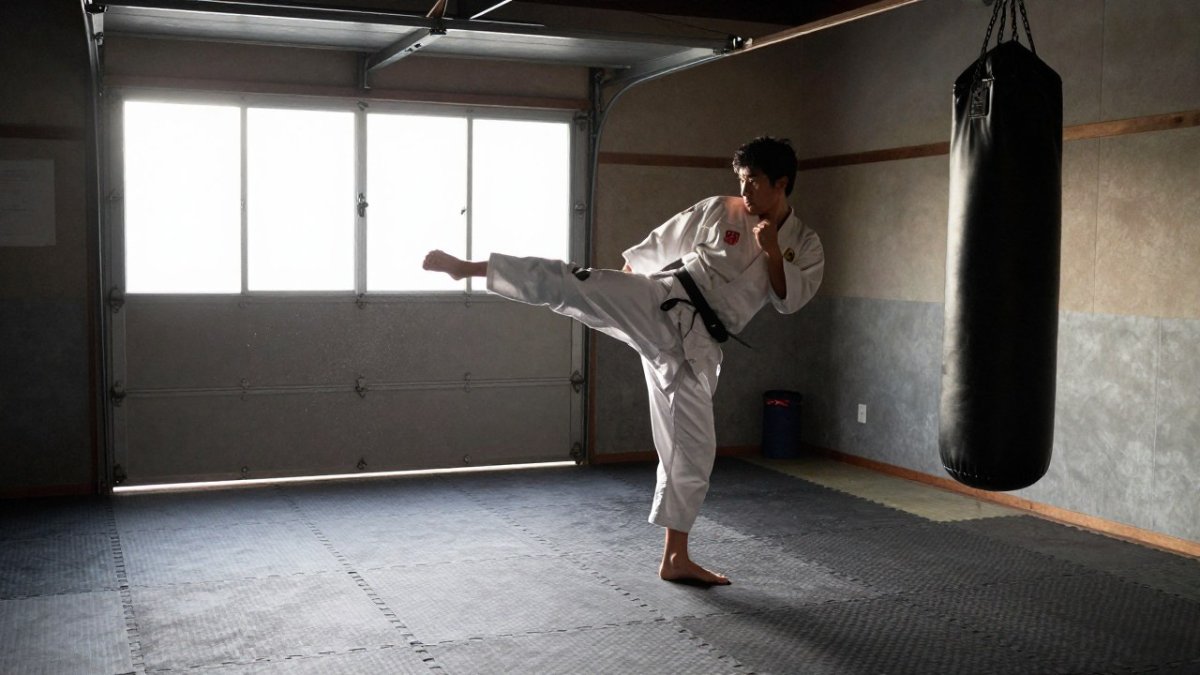
Choosing the best martial arts mats for a garage gym is harder than choosing mats for a commercial dojo. A garage has concrete floors, temperature swings, moisture, and limited room. Glory and Power Enterprises builds competition spring floors and sprung floors for cheerleading, gymnastics, martial arts, and dance, so the guidance here focuses on the surface and impact needs of training at home.
Concrete is hard and cold, and it sends impact straight back up through the body. A vinyl bonded foam option for BJJ and tumbling on concrete is one way to add cushioning in a garage. A mat that works well on a sprung gym floor may feel thin and unforgiving on bare concrete. Mats also need to resist moisture rising through the slab, which is common in attached garages and older homes.
Many home practitioners find that the right mat depends on what they train. Grappling needs a thicker, softer surface for throws and falls. Striking needs firmer footing and a surface that stays put under sprawling feet. A garage that doubles as a car space or workshop adds the need to roll out, fold away, or store the mat when it is not in use.
Quick Comparison: Top Martial Arts Mats for a Garage Gym
Several mat formats are sold for home training. The table below summarizes the options covered in this guide. Prices are not listed because the research did not verify them, and pricing depends on size, thickness, quantity, and delivery. Contact Glory and Power Enterprises for a current quote.
| Option | Format | Best For | Main Limitation |
|---|---|---|---|
| Karate puzzle mats (EVA foam) | Interlocking tiles, 1 inch thick | DIY layouts and shock absorption | Thin for hard throws; seams need care |
| Zebra Athletics home gym kits | Kits up to 20 by 20 feet | Dedicated training rooms for BJJ and MMA | Thickness and surface details not confirmed |
| Zebra Athletics roll-out mats | Roll-out format | Storing mats when the garage is shared | Dimensions and thickness not confirmed |
| Zebra Athletics rubber tiles | Modular tiles | Protecting garage floors | Tile size and thickness not confirmed |
| Horse stall mats | Rubber flooring | General floor and equipment protection | Not established for martial arts impact |
Pros and cons at a glance:
- Puzzle EVA mats: Waterproof and light at 8 pounds per 3.28-by-3.28-foot tile, but thin for heavy grappling.
- Roll-out mats: Easy to store, but seams can separate under repeated throws.
- Rubber tiles: Strong floor protection, but the firm surface may not suit falls.
Best BJJ Mats for Home Training Spaces
Brazilian jiu-jitsu is the most demanding common use for a home mat. Repeated takedowns, guard pulls, sweeps, and groundwork concentrate load on small contact points, a knee, a hip, a shoulder, and foam that is too soft bottoms out under that load, which means the concrete underneath starts doing the work.
The mechanism is straightforward. Foam cushions by compressing and recovering. Every landing compresses the cells; if the foam is not dense enough, the cells collapse permanently and the mat develops flat, hard spots exactly where knees and hips land most often. That is why a thick but low-density mat can feel worse after a year than a thinner, denser one.
For home grappling, a common pattern is a vinyl-covered bonded foam or a closed-cell foam core in the 1.5- to 2-inch range over a firm base, with a vinyl top for moisture resistance and easy cleaning. You can compare the specific vinyl bonded foam roll mat that suits this description.
Surface choice changes how the mat performs under bare feet. A vinyl top resists sweat and moisture and wipes clean, which matters in a garage where humidity swings. A carpet-bonded top grips differently and can feel warmer, but it holds chalk, hair, and dust and is harder to sanitize. For BJJ, where faces and bare skin contact the surface constantly, vinyl is usually the easier surface to keep clean.
Watch out: a mat that feels adequately cushioned for drilling can still be too thin for live takedowns, especially for beginners who have not learned to break falls. Test the mat with the hardest fall you expect to take, not the average drill, and keep the mat's edge away from walls, tools, and bare concrete within falling distance.
Measure the training area before buying, then confirm the mat's footprint leaves clear space around the edges for safe movement and for rolling out of a throw. If the mat will be stored between sessions, check that the roll diameter fits your wall space and that the mat can be rolled without cracking the vinyl in cold weather.
Roll-Out Martial Arts Mats vs. Interlocking Foam Mats
Roll-out and interlocking mats solve the same problem in different ways, and the right choice depends on how often the mat moves.
Roll-out mats come in large sheets. They produce a continuous surface with few seams, which helps when rolling and sweeping. They are heavier to move and need enough wall space to store when rolled up.
Interlocking foam mats are assembled from tiles that snap or fit together. They are easier to lift and reconfigure, and they let you fit the mat to an irregular garage floor. The trade-off is seams. Under heavy throws, tiles can shift apart, creating gaps that catch a foot or hand.
For a garage that also holds a car or workbench, roll-out mats usually store more neatly. For a permanent training corner where you want to set the layout once, interlocking tiles are often simpler.
Interlocking Foam Mats for Martial Arts: Thickness, Density and Sizing
Interlocking foam is a common DIY option, and it is also a format that is easy to mis-size. This section gives you a simple method to estimate tile count, explains how thickness and density trade off against each other, and compares interlocking tiles against roll-out and folding formats so you can pick the right one for your garage.
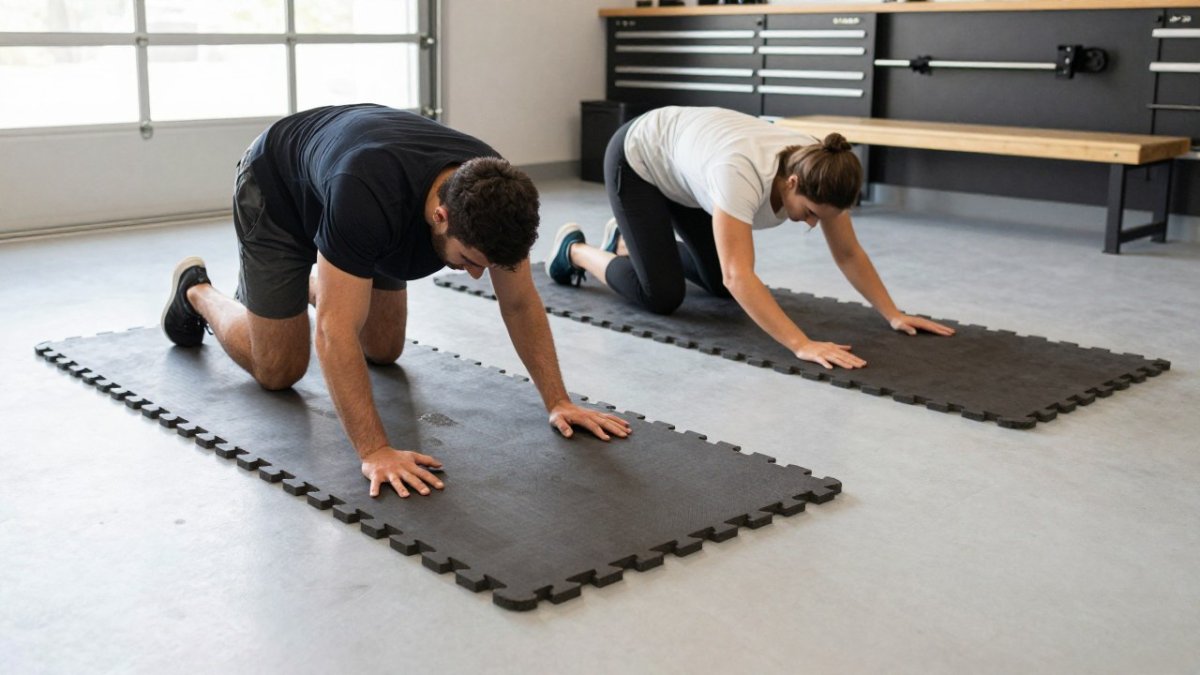
Sizing method. Measure the usable floor area, not the whole garage. Subtract space taken by cars, workbenches, shelving, and door swings. Then add a margin of at least 2 feet on every open side for movement and falls, more if you plan throws or takedowns. For a 10-by-10-foot training area with a 2-foot margin on two sides, you are really laying a 10-by-14-foot mat.
Thickness. One inch of foam is adequate for striking drills and light grappling, but it compresses quickly under repeated hard landings. For heavy throwing, many practitioners prefer thicker bonded foam or a spring floor system, where the cushioning is engineered for impact rather than relying on foam density alone. Thickness alone does not guarantee protection, a thick, soft mat can bottom out just as fast as a thin, firm one.
Density and firmness. Density controls firmness. Denser foam feels stable underfoot and resists compression, which helps footing for striking. Softer foam absorbs more of a fall but can feel unstable during footwork. Test a sample by standing on it and dropping from a kneeling position before committing to a full layout.
Format comparison. Interlocking tiles are easy to lift and reconfigure, but seams can shift under heavy throws. Roll-out mats produce a continuous surface with fewer seams, but they are heavier to move and need wall space to store. For a garage that also holds a car or workbench, roll-out or folding mats usually store more neatly. For a permanent training corner where you want to set the layout once, interlocking tiles are often simpler.
Watch out: cheap interlocking tiles can separate at the seams under repeated throws, creating gaps that catch a foot or hand. Check that the tiles have a positive locking mechanism, not just a friction fit, and press every seam fully together before training.
Installing Martial Arts Mats on a Concrete Garage Floor
Installation on concrete starts with moisture. Concrete can release water vapor from below, and a mat laid directly on a damp slab can trap it and encourage mold or odor. Before laying any mat, sweep the floor, check for visible dampness, and use a moisture test kit or a sheet of plastic taped to the slab overnight. A setup guide for sprung floors in small, hard-floored spaces covers layout limits for tight rooms. If condensation forms under the plastic, add a vapor barrier or raise the mat on a subfloor.
Temperature matters as well. Store mats indoors for at least several hours before installation so they can reach room temperature. Keep the area ventilated to avoid trapping vapor.
For layout, lay the first tiles in the center of the training area and work outward. Press each seam together and check that the edges line up before moving on. Edge ramps or tapered borders reduce the trip hazard where mat meets bare concrete, which is especially important for practitioners learning to fall.
Safety limits apply to every setup. A mat reduces impact but does not eliminate the risk of head or neck injury on concrete. Keep the area clear of tools, equipment, and walls within arm's reach, and avoid hard throws onto unprotected edges.
Choosing Your Garage Gym Mat: Next Steps for Your Training Space
Start by listing what you train. Grappling calls for thicker, more cushioned surfaces. Striking benefits from firmer footing. Measure the garage floor, check moisture, and decide whether the mat must roll up for storage. Then compare formats against those needs.
Glory and Power Enterprises builds spring floors, sprung dance floors, carpet bonded foam, and landing mats for martial arts and other training. If you want to see the carpet bonded foam range, browse it on the company's product page: browse carpet bonded foam. Current pricing depends on quantity, dates, and delivery, so request a quote from the company before you budget. Check local building or fire rules if you plan a permanent installation in an attached garage.
Frequently Asked Questions
What are the best mats for a garage martial arts gym?
The best choice depends on your discipline and how often you train. Interlocking foam tiles suit most garage martial arts gyms because they go down quickly and can be rearranged. Roll-out mats work well when you want a single continuous surface and plan to store the mat after sessions. Rubber garage flooring protects the concrete and equipment but offers less cushioning for throws and falls. Check thickness, density and whether the mat is waterproof before you buy, since garage floors can be damp or cold.
Are puzzle mats suitable for grappling?
Puzzle or interlocking foam mats can be suitable for grappling, especially for drilling, positional work and light sparring, provided the mats are dense enough to resist compression. Look for high-density EVA foam and a tight interlock so seams do not separate under pressure. For heavy throws or frequent takedowns, thicker mats and a firmer surface give better impact protection. Puzzle mats are generally more practical for a home gym than for a competition-style training area.
How thick should martial arts mats be for a home gym?
Many home practitioners use mats about one inch thick for general training, which provides enough cushioning for drills and light falls. Thicker mats, often 1.5 to 2 inches, offer more impact absorption for throws and landings but can be less stable underfoot. Thickness should match the training you do most. Density matters as much as thickness, because a thick but soft mat can compress too much and feel unstable during grappling.
Can you put martial arts mats directly on a concrete garage floor?
You can place most martial arts mats directly on a concrete garage floor, but a moisture barrier or a rubber underlayment helps prevent dampness from reaching the foam and reduces the risk of mold. Concrete is hard and cold, so the mat provides the main cushioning. Sweep and check the floor for cracks or debris before installation, and allow the garage to reach a stable temperature because cold conditions can make foam stiffer and less forgiving.