 listicle
7 Best Landing Mats for Competitive Cheer
Last Updated: October 28, 2026
Quick Summary
The best landing mats for competitive cheer cushion hard, repeated landings, grip the floor, stay flat during practice, and roll up or fold for storage. Choose by impact absorption, fit for your training space, and the expectations of the events you attend. Roll-out mats suit long tumbling lanes, while folding or panel mats suit stunt groups.
- Confirm the thickness your competitions expect before buying, since metric and inch specs differ.
- Foam density, foam type, layering, and cover construction all affect cushioning as much as thickness.
- Roll-out mats of about 40 feet or more let athletes finish tumbling passes without running off the end.
- Inspect seams and cover before each session and replace damaged sections before athletes train on them.
- Store roll-out mats upright or on a rack, since rolling too tightly creates permanent creases.
Table of Contents
- What Makes a Landing Mat Right for Competitive Cheer
- Cheerleading Landing Mat Thickness: How Much Cushion You Need
- Competition Landing Mat Dimensions and Roll Length
- Our Shortlist: 6 Landing Mats Compared Side by Side
- Cheer Floor and Landing Mat Comparison: Which Setup Fits Your Gym
- Cheer Mat Safety and Maintenance
- Choosing Your Competitive Cheer Mat Setup
- Frequently Asked Questions
What Makes a Landing Mat Right for Competitive Cheer
Choosing a landing mat for competitive cheer comes down to impact absorption, fit for your training space, and whether it meets the expectations of the events you attend. Glory and Power Enterprises builds competition spring floors and landing mats for cheerleading and gymnastics.
A competition-grade landing mat should cushion hard, repeated landings from stunts, tumbling passes, and jumps, grip the surface beneath it, stay flat during practice, and roll up or fold for storage. Dimensions, foam density, and cover material all affect how well it performs.
Most cheer programs mix landing surfaces: roll-out mats for long tumbling lanes, folding or panel mats for stunt groups. Match the mat to the skills you train, a mat that feels soft for beginners can be too forgiving for advanced tumbling, where a firmer landing builds body control. Coaches should test landings before buying.
Cheerleading Landing Mat Thickness: How Much Cushion You Need
Thickness is the most common question buyers ask about cheer mats, but it tells you less than most product pages imply. What matters is how a given thickness of foam behaves under a specific landing.
The common thickness range
Greatmats lists its cheerleading roll-up mats in 1-3/8-inch and 2-inch thicknesses, noting the thicker option cushions hard landings better, a practical comparison range for roll-up tumbling mats.
Competition landing mats for gymnastics are often listed in centimeter thicknesses, American Gymnast lists 12-centimeter competition landing mats in its artistic gymnastics category. Confirm a mat's stated thickness matches your event requirements, because metric and inch specs are not interchangeable.
What thickness can and cannot tell you
Thickness is a proxy for cushioning, not a guarantee of impact protection. Two mats at the same thickness can perform very differently depending on foam type, density, and layering.
- Foam density: Soft, low-density foam can compress too much and feel unstable; firmer, higher-density foam may absorb repeated landings better and hold its shape longer.
- Foam type: Polyethylene and crosslinked polyethylene resist compression set; polyurethane is softer but breaks down faster under daily high-impact use.
- Layering: A firm base with a softer top layer cushions initial impact without bottoming out; a single-density mat at the same thickness feels different.
- Cover and seam construction: A bonded carpeted or vinyl cover spreads force across the surface; separated seams or a loose cover reduce protection.
Landing mats vs. crash mats vs. skill cushions
Thickness questions often come from confusing three products:
- Landing mats are the firm, roll-out or panel surfaces athletes land on during tumbling and stunting, built for repeated landings and a consistent feel.
- Crash mats are thicker, softer mats for learning new skills safely, such as a first back tuck. They are not meant for repeated competition-style landings because the softness changes landing mechanics.
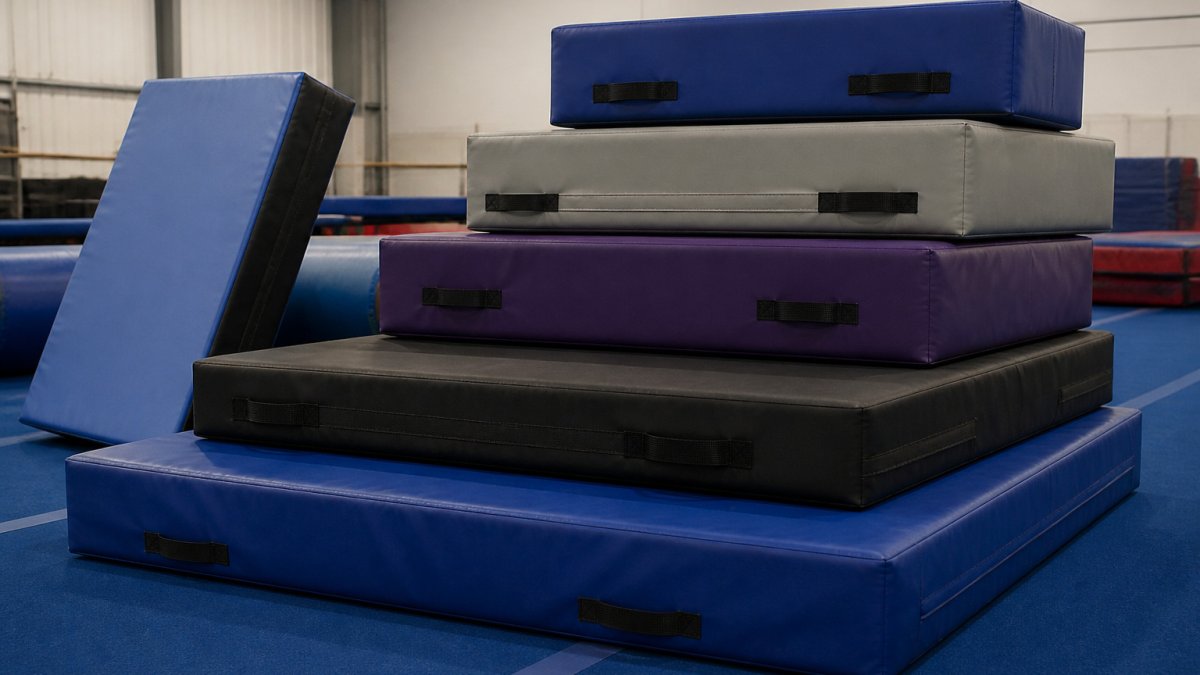
- Skill cushions and shapes, wedges, blocks, and inclines, break down a skill or build body positions. They supplement a landing mat; they do not replace one.
Factors that should drive your thickness choice
- Event requirements: Confirm the thickness your competitions expect.
Competition Landing Mat Dimensions and Roll Length
Dimensions determine how much training space a mat covers, how easily it fits your facility, and whether it is usable at the events you attend. Roll-out mats are measured by width, length, and thickness, and length often determines whether a tumbling pass can run without stopping.
Common sizes and what they support
Greatmats offers a 6-by-42-foot roll-up cheerleading mat. Compare sizes by skill, not just square footage:
- Tumbling lanes: A long roll, roughly 40 feet or more, lets an athlete complete a pass without running off the end. A 6-foot width gives room for most passes; narrower mats force athletes to stay centered.
- Stunt landings: Stunt groups need a wider, shorter surface, often a panel or folding mat, so the whole group can land and spot safely. A long tumbling roll is inefficient here.
- Mixed-use gyms: Shared spaces often use modular panels or shorter rolls that reconfigure, accepting seams for flexibility.
- Home and small-space training: Shorter rolls and folding mats fit basements and garages, but confirm the length still supports the skills being trained.
How dimensions relate to competition rules
Dimensions are often tied to what a competition or governing body will accept on the floor. Confirm a mat's specifications match your event requirements before buying, because a mat built to one sport's spec may not satisfy another sport's rules. A practical approach:
- Identify the organizations and events you compete in. Rules can differ between school, all-star, and collegiate competition, and between sanctioning bodies.
- Request the current equipment or floor specification from each organization or event organizer, asking about mat dimensions, thickness, surface material, and any certification or labeling requirement.
- Compare the spec to the product data sheet, not the marketing description, exact dimensions, thickness in the unit the rule uses, and surface material.
- Confirm with the manufacturer that the mat is built to that specification, and ask whether it has been used at comparable events.
- Re-verify each season. Rules can change, and a mat that was compliant last year may not be this year.
Measuring your space before you order
Before ordering, measure your practice space and mark where mats will sit, leaving clearance to step on and off and run-out space beyond a tumbling lane. Check that the roll length fits your storage area, a 42-foot roll that cannot be stored without creasing wears out faster at the folds. Also measure doorways, stairs, and turns between delivery and the training area.
Width, seams, and connection
A wider mat gives more lateral room for tumbling and stunting but weighs more and is harder to move; narrower mats are easier to handle but leave less margin for error. Seams are the trade-off of modular systems, they can shift, catch a foot, or separate over time. Hook-and-loop fasteners keep sections aligned, so inspect seams regularly and replace fastener strips when they stop holding.
Our Shortlist: 6 Landing Mats Compared Side by Side
This shortlist compares landing mat options from the research available. Pricing and specifications vary by product and configuration, so use this table to narrow your choices, then request quotes.
| Product | Format | Thickness | Price Information | Best For |
|---|---|---|---|---|
| Greatmats 6x42 Roll-Up Cheerleading Mats | Roll-up | 1-3/8 in or 2 in | Contact for pricing | Long tumbling lanes |
| American Gymnast 12cm Competition Landing Mats | Competition | 12 cm | From $1,030 (category range $1,030 to $3,310) | Competition-spec landing mats |
| UCS Spirit Stunt Landing Mats | Stunt landing | Not listed | Contact for pricing | Dedicated stunt landings |
| Flooring Inc Cheer Mats | Roll-out and panel | Not listed | Contact for pricing | Portable multi-format setups |
| Resilite Cheer Mats and Skill Shapes | Mats and skill shapes | Not listed | Quote-based | Skill development programs |
| Glory and Power Enterprises Landing Mats | Competition and training | Varies by configuration | Pricing depends on quantity, dates, and delivery | Programs wanting a spring-floor and landing-mat setup |
Greatmats 6x42 Roll-Up Cheerleading Mats
This roll-up mat has a carpeted surface for traction and a 6-by-42-foot format that supports tumbling runs without frequent repositioning. Two thickness options balance cushioning against control.
American Gymnast 12cm Competition Landing Mats
These mats are listed in the artistic gymnastics category with a 12-centimeter thickness. Because the listing is aimed at artistic gymnastics, confirm with the manufacturer that the mat suits cheer skills before purchasing.
UCS Spirit Stunt Landing Mats
UCS Spirit designs these mats for stunt landings and says they serve both gymnastics and cheer practice. Dimensions, construction details, and pricing were not available, so request specifications directly.
Flooring Inc Cheer Mats
Flooring Inc offers roll-out and panel formats for tumbling, stunting, and jumps, making it easier to match the mat to each drill. Specific dimensions and thicknesses were not listed.
Resilite Cheer Mats and Skill Shapes
Resilite sells cheer mats alongside skill shapes designed for cheer athletes and coaches, suiting programs that want equipment for both landing practice and skill building. Pricing is quote-based.
Glory and Power Enterprises Landing Mats
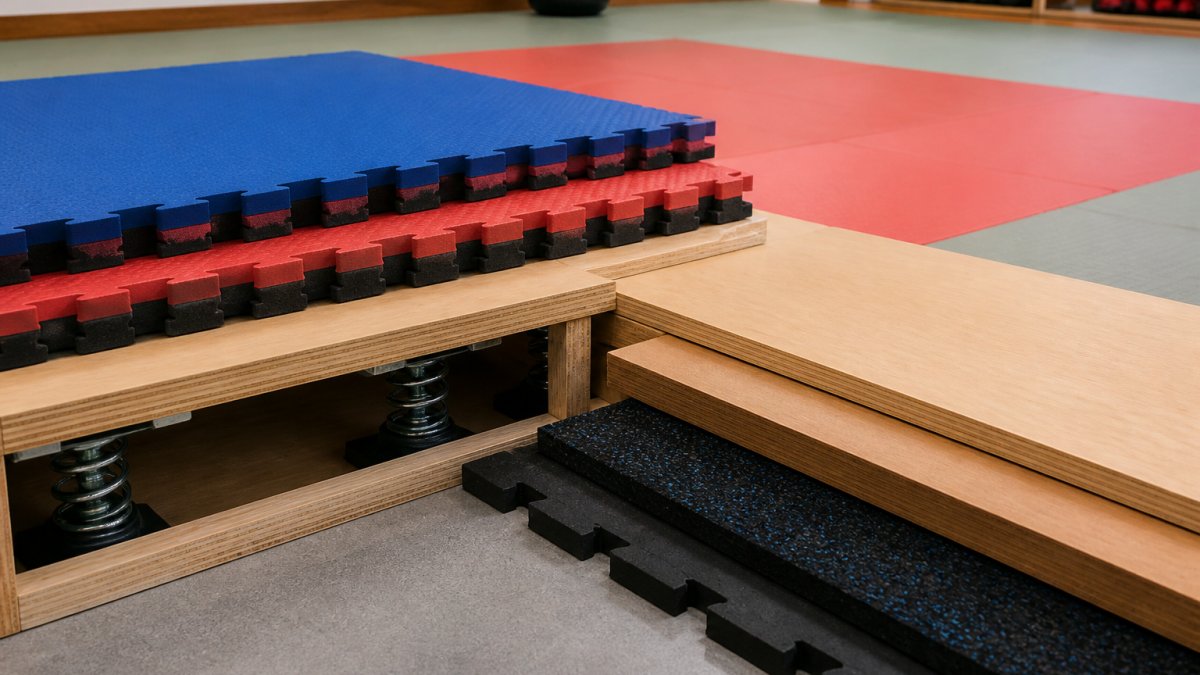
Glory and Power Enterprises manufactures competition spring floors and specialized landing mats for cheerleading, gymnastics, and dance. Its spring floors use two-layer Baltic birch construction with power springs secured by bolt and thread-locker, and each board includes 1 linear foot of hook-and-loop fastener. Shipping regions are customizable, and financing options are available. Pricing depends on quantity, dates, and delivery, so contact the company for a quote.
Cheer Floor and Landing Mat Comparison: Which Setup Fits Your Gym
A landing mat adds cushioning on top of an existing floor, while a sprung floor provides spring and give across the whole training area. Many programs use both: a sprung floor for tumbling and a landing mat for high-impact skills. Roll-out mats suit gyms that change layouts or share space; panel mats suit fixed setups where seams are acceptable. Spring floors cost more to install but reduce joint strain over long sessions. Ask yourself: will the surface stay in one place or move between uses? Do athletes train on it daily or only for competition prep? Does your floor need added cushioning, or does it already have spring? Can your budget cover installation, shipping, and storage?
Cheer Mat Safety and Maintenance
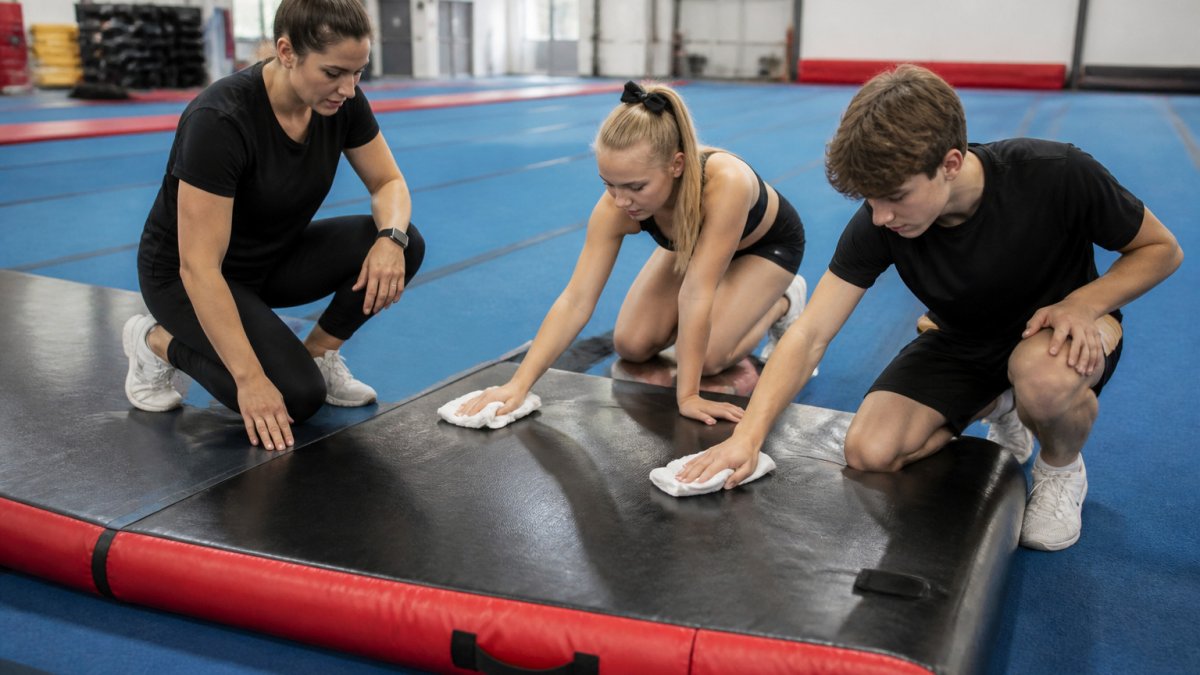
Safety starts with the right mat for the skill: practice new, higher-risk skills on thicker surfaces and progress to thinner mats as control improves. Keep mats flat, free of gaps, and fastened where panels meet. Inspect before each session for worn carpet, separated seams, cracked covers, and unevenly compressed foam, and replace damaged sections before athletes train on them. Clean surfaces regularly to remove grip-reducing dust and debris. Store roll-out mats upright or on a rack away from moisture and direct sunlight, since rolling too tightly creates permanent creases. Track use and budget for replacement, mats lose cushioning gradually, and a worn mat may look fine while providing less protection.
Choosing Your Competitive Cheer Mat Setup
Glory and Power Enterprises can provide details on its spring floors, including customizable shipping regions and financing options, so contact the company for current pricing and availability.
Frequently Asked Questions
What type of landing mat is best for competitive cheer?
The best landing mat depends on the skills your team trains most. Compare options before you buy, and match the mat to your most frequent drills.
What thickness should a cheer landing mat be?
Choose a mat based on your athletes' skill level and the heights they train at.
How large should a competitive cheer landing mat be?
Roll-out cheer mats are often 6 feet wide and 42 feet long, which gives tumbling passes room to run. Panel mats let you build a custom footprint for stunt groups and jump areas. Measure your training space first, leaving clearance around each mat for safe movement. Consider how many athletes will use the mat at once, because a larger surface supports more simultaneous drills.
Can competitive cheer landing mats be used for tumbling practice?
Yes. Roll-out mats are commonly used for tumbling because their length supports running passes and series. Look for a carpeted or grippy surface that gives athletes traction when they push off. Check that the mat's thickness and firmness suit the tumbling skills you teach, since lighter mats may not provide enough landing cushion for higher-impact passes.