 Ultimate guide
Spring Floor Shock Absorption Testing Standards Explained
Last Updated: November 9, 2026
Quick Summary
Spring floor shock absorption is the measured ability of a floor system to reduce landing force, tested under standards like ASTM F2772-24, DIN 18032-2, or EN 14904. Each standard uses its own drop device, height, and thresholds, so results from different methods cannot be compared directly. Always request the full test report, including the standard edition and device used.
- ASTM F2772 covers surface performance properties, not structural engineering or installation quality.
- Force reduction testing drops a known mass and reports the percentage of impact absorbed versus concrete.
- Read force reduction and vertical deformation as a pair; excessive deformation signals a soft, fatiguing floor.
- A credible report names the standard edition, device model, drop height, conditioning period, and test locations.
- Confirm the tested sample matches production construction, since prototype results do not bind the manufacturer.
Table of Contents
- Why Shock Absorption Testing Decides Whether a Spring Floor Is Safe
- What ASTM F2772-24 Covers and Where Its Limits Sit
- Force Reduction Testing Methods: How the Numbers Are Produced
- Reading Force Reduction and Vertical Deformation Results Together
- Gymnastics Floor Safety Requirements and the Standards Behind Them
- How Construction, Subfloor and Upkeep Change Test Performance
- Evaluating a Test Report Before You Approve a Spring Floor Order
- Requesting Test Documentation With Your Spring Floor Quote
- Frequently Asked Questions
Why Shock Absorption Testing Decides Whether a Spring Floor Is Safe
Spring floor shock absorption is the measured ability of a floor system to reduce the force that travels back into an athlete's body on landing. That spring floor shock absorption measurement is not a marketing claim; it is a test result, produced under a defined standard, and it is the first thing a gym owner should demand before signing an order.
Landing forces are the reason this matters. A gymnast or cheer athlete returning to the floor from height generates an impact load that the body must absorb if the floor does not. The American Society for Testing and Materials publishes the standard most U.S. buyers encounter, and it is the reference point for nearly every spring floor specification sheet on the market.
Below, we'll show you exactly how the test is run, where the standards diverge, and what a credible report looks like.
What ASTM F2772-24 Covers and Where Its Limits Sit
ASTM F2772 is the standard specification for athletic mats and floor systems used in indoor sports, and the -24 suffix marks the edition year. It sets minimum performance properties and defines the test methods used to verify them.
The scope is narrower than many buyers assume. It addresses surface performance properties, not structural engineering, not installation quality, and not the longevity of the spring system underneath. A floor can pass the standard and still be built on a subfloor that will not perform as tested.
That distinction is where procurement mistakes start. A certificate of compliance tells you the sample tested met the thresholds. It does not tell you the production run matches the sample, or that the floor suits your specific sport.
Force Reduction Testing Methods: How the Numbers Are Produced
Force reduction testing drops a known mass onto the floor from a fixed height and measures how much of the resulting impact the floor absorbs versus a rigid concrete reference surface. The output is a percentage: the force reduction percentage.
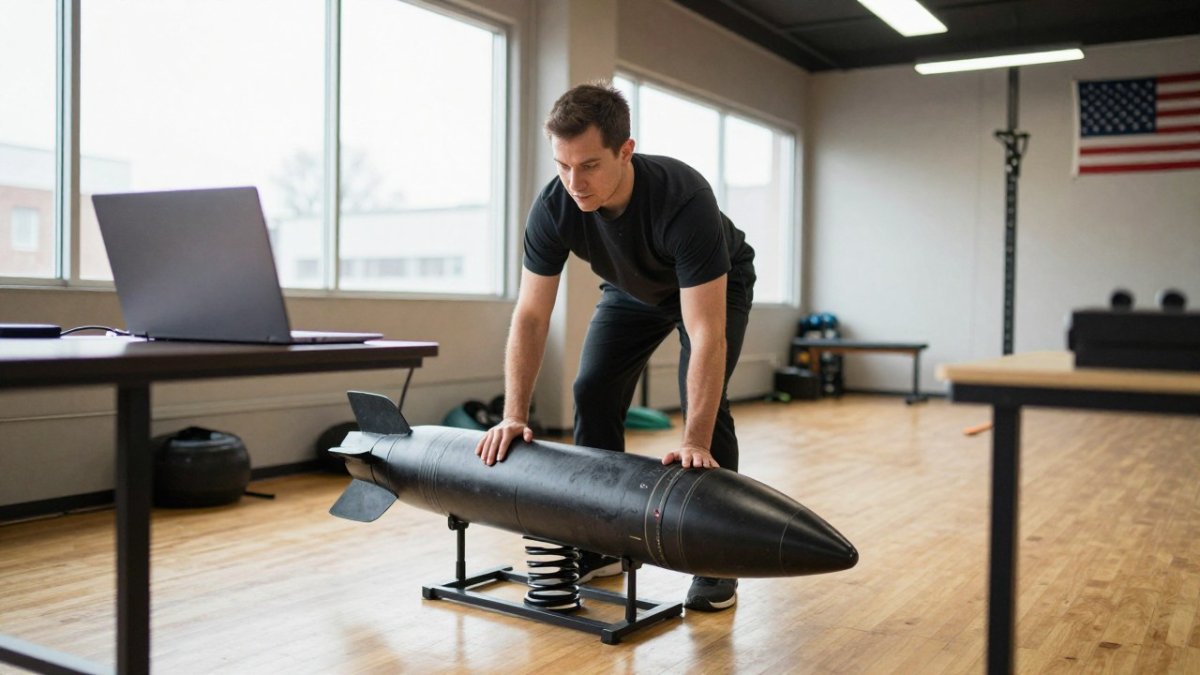
The equipment matters as much as the procedure. DIN, the German Institute for Standardization maintains DIN 18032-2, a widely referenced method for sports floor testing that uses a guided missile-shaped impact device with an accelerometer.
A practical spring-floor test run follows a repeatable sequence, and each step changes the number on the report:
- Condition the sample. Standards specify how long a sample must sit at a controlled temperature and humidity before testing. Skipping conditioning inflates results because a freshly manufactured panel is stiffer than a settled one.
- Calibrate the device. The accelerometer and drop mechanism are checked against a reference before the first drop. An uncalibrated device can shift a reading by several percentage points.
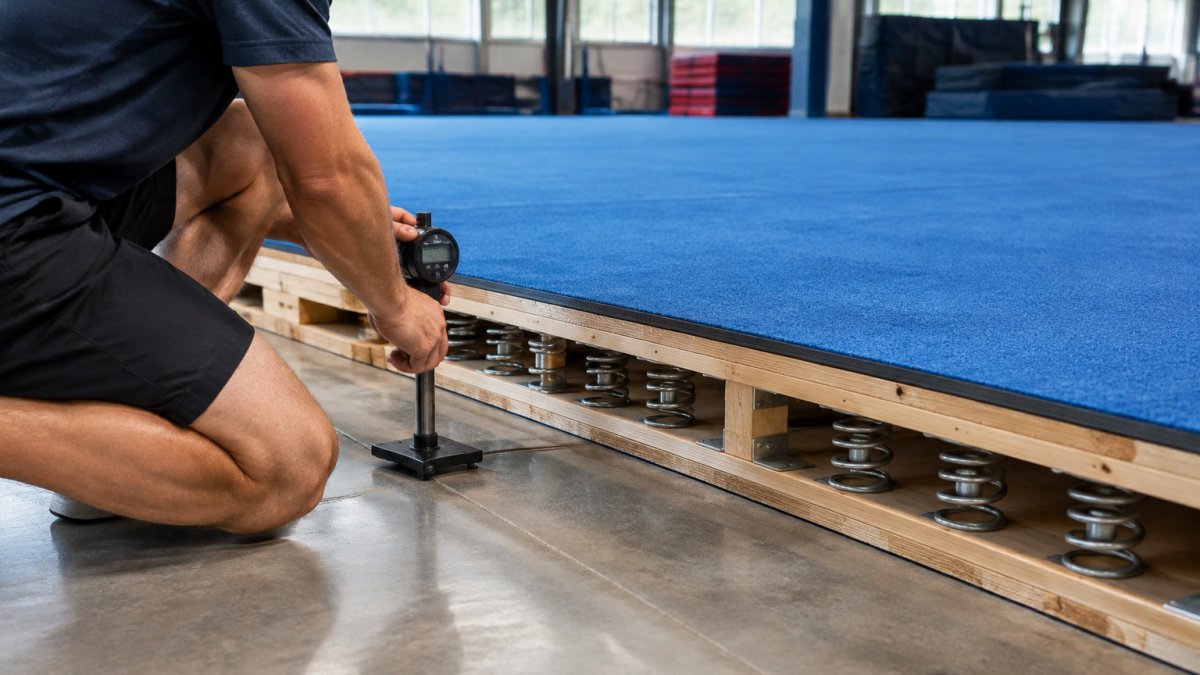
- Map the sampling locations. Readings are taken at center court, near seams, at panel joints, and at the floor edge. A spring floor is not uniform, and edge readings routinely differ from center readings because the spring grid is bounded by the frame.
- Take repeat drops. Most methods call for multiple drops per location and report an average, because a single drop is noisy. Ask how many drops per location were averaged.
- Record the environment. Floor temperature, age since installation, and subfloor condition all move the result. A floor tested the day after installation is not the floor you will have in year three.
Three variables change the number you see on a report:
- Test location. Readings taken near a seam or at the floor edge differ from center-court readings.
- Floor temperature and age. A floor tested the day after installation is not the floor you will have in year three.
- Sample conditioning. Standards specify how long a sample must sit before testing; skipped conditioning inflates results.
Watch out: a single force reduction figure with no stated test location, device model, or conditioning period is not verifiable. Ask for the full method description, not just the headline number.
For a spring floor specifically, the test result is a property of the assembled system, springs, attachment hardware, and panel layers together.
Reading Force Reduction and Vertical Deformation Results Together
Vertical deformation is the distance the floor surface deflects under the impact load, and it is inseparable from force reduction. A floor that absorbs force by deflecting too far creates a different problem: the athlete loses stability and the spring system takes structural stress.
The two figures are read as a pair. High force reduction with excessive vertical deformation suggests a soft, slow floor that will fatigue. Moderate force reduction with controlled deformation usually indicates a well-tuned spring system.
Area elasticity and point elasticity describe how the floor responds across a region versus at a single point. Floor uniformity ties them together: a floor with excellent point readings but poor uniformity will feel inconsistent underfoot, and inconsistency is what athletes notice first.
Gymnastics Floor Safety Requirements and the Standards Behind Them
Gymnastics floor safety requirements in the U.S. are largely set by the standards bodies and the sport's governing organizations rather than by a single federal regulation. Buyers should expect to see compliance referenced to ASTM F2772, and for international events, to EN 14904 or DIN 18032-2.
The table below sets out what each standard actually covers, so you can tell which one a supplier's claim is built on:
| Standard | Scope | What It Governs | Edition Caution |
|---|---|---|---|
| ASTM F2772 | Athletic mats and indoor sports floor systems | Surface performance properties: force reduction, vertical deformation, energy restitution, area and point elasticity, uniformity | The edition year (for example, -24) matters; older editions may not reflect current thresholds |
| DIN 18032-2 | Sports floors for indoor athletic use | Force reduction, vertical deformation, and related performance via a guided missile device | A long-standing European method; thresholds and device differ from ASTM |
| EN 14904 | Indoor sports surfaces | Performance classes for force reduction, deformation, and ball rebound | Class-based rather than a single pass/fail threshold |
| ANSI E1.26 | Entertainment and stage flooring | Impact attenuation for staged events | Different application entirely; not a gymnastics floor standard |
These standards are not interchangeable. Each defines its own drop height, device, and threshold, so a force reduction percentage from one method cannot be compared directly to a figure from another.
The edition question is where procurement claims often break down. ASTM F2772 is revised periodically, and a report citing an older edition may have been tested against thresholds that have since changed. When a supplier says "meets ASTM F2772," ask which edition, and whether the report predates the current one.
The practical takeaway for a gym owner is to specify the standard, the edition, and the test method in the purchase order. For broader context on how impact reduction is framed across flooring types, see impact reduction standards for gymnastics flooring.
How Construction, Subfloor and Upkeep Change Test Performance
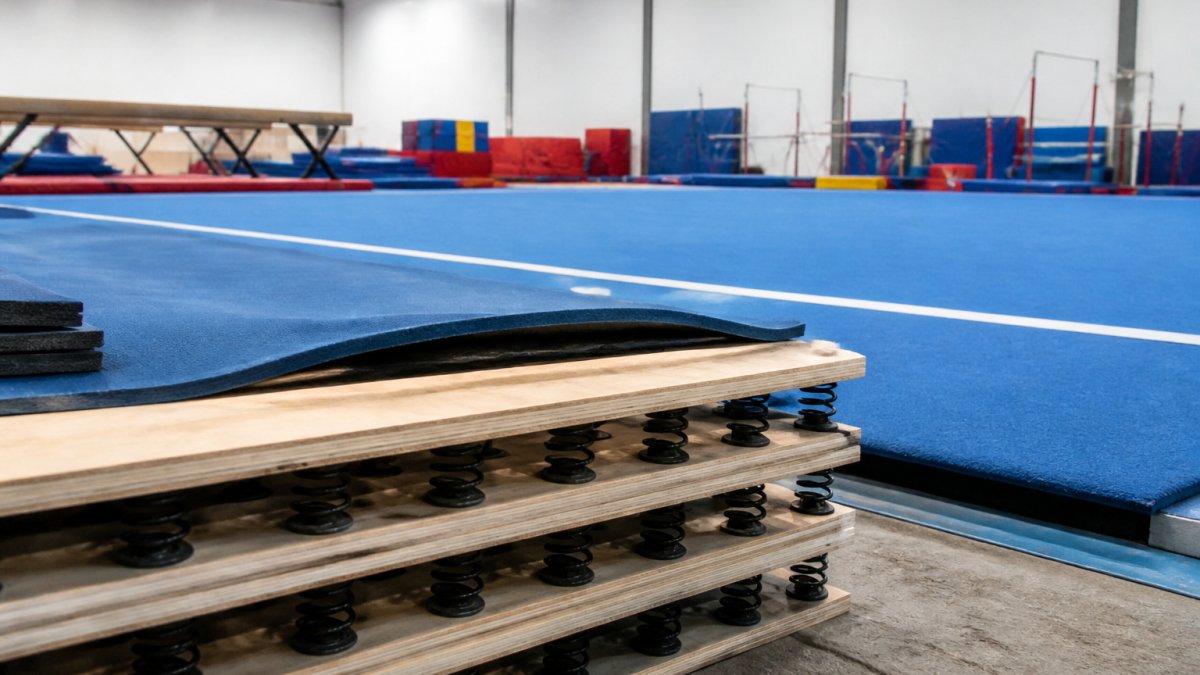
Construction determines whether a floor can hold its tested performance over time. Spring count, spring attachment method, and the number of wood layers all affect how impact forces distribute across the floor system.
Glory and Power Enterprises builds two-layer Baltic birch spring floors with power springs secured by bolt and thread-locker. Cheer and gymnastics spring floor designs explains how those layers and the Baltic birch standard fit together.
Subfloor condition is the silent variable. A tested floor installed over an uneven or damp subfloor will not reproduce its lab numbers. Upkeep matters too: loose fasteners, compressed foam, and worn carpet all shift the readings downward over time.
Evaluating a Test Report Before You Approve a Spring Floor Order
A credible test report contains five elements. Check for each before you sign:
| Report Element | What to Verify | Why It Matters |
|---|---|---|
| Standard and edition | ASTM F2772-24 named explicitly | Older editions may not reflect current thresholds |
| Test method | Device model, drop height, conditioning period | Without these, the number is unverifiable |
| Test locations | Center, edge, seam readings listed | Single-location results hide weak spots |
| Sample identity | Production sample, not prototype | Prototype results do not bind the manufacturer |
| Date of testing | Recent and tied to your order | Stale reports may predate a material change |
What most guides miss is the sample identity row. A manufacturer can pass a standard using a hand-built prototype and ship a different production floor. Ask for confirmation that the tested sample matches the construction you are buying. The competition grade spring floor buyer's guide ties this documentation directly to the purchase decision.
Requesting Test Documentation With Your Spring Floor Quote
Build the request into the quote stage, not the delivery stage. By then, the use is gone.
Ask for the test report, the standard edition, the device used, and the test date in the same email as your quote request. A supplier who manufactures to a standard will have these on hand. One who does not will deflect.
Glory and Power Enterprises supplies two-layer Baltic birch competition spring floors with power springs secured by bolt and thread-locker. Review a representative competition spring floor with two-layer Baltic birch construction to see how the build matches the documentation you are requesting.
The gym owners who avoid expensive mistakes are the ones who treat a test report as a purchasing document, not a formality. Request it early, read the method section, and compare only like with like.
Glory and Power Enterprises manufactures two-layer Baltic birch spring floors with power springs secured by bolt and thread-locker, built for competitive training environments. Visit the Glory and Power Enterprises website to order or request a quote.
Frequently Asked Questions
What is the ASTM F2772 standard for sports flooring?
ASTM F2772 is the standard specification for athletic surfaces used indoors, and it sets minimum performance properties for shock absorption, vertical deformation, ball rebound, and surface friction. The current edition, ASTM F2772-24, classifies floors into performance levels rather than declaring one universal pass mark. That means a floor can comply at a level suited to physical recreation or to elite competition. When you review a spring floor quote, ask which classification level the floor was tested to, not simply whether it passed.
How is force reduction measured in spring floors?
Force reduction is measured by dropping a known mass onto the floor and recording how much of the impact the surface absorbs compared with a rigid concrete reference. The result is expressed as a percentage: a higher figure means more impact energy is dissipated before it reaches the athlete. Force reduction testing methods require the drop point, the equipment and the surface condition to be controlled, because readings shift with temperature, moisture and where on the panel the test lands. Test reports should state the method and the number of test locations.
What is the difference between shock absorption and vertical deformation?
Shock absorption, often reported as force reduction, describes how much impact energy the floor takes out of a landing. Vertical deformation describes how far the surface deflects downward under that same load. The two are related but not interchangeable: a floor can absorb energy while deflecting a little or a lot. Deformation matters for stability and for how the floor feels underfoot, while force reduction matters for the load reaching joints. Read both figures together, because a single number never tells the full story of how a spring floor behaves.
Do competition spring floors require specific safety certifications?
There is no single federal certification that a competition spring floor must carry. Compliance is usually demonstrated through test reports showing the floor meets a recognized standard such as ASTM F2772-24, and sometimes DIN 18032-2 or EN 14904 for comparison. Governing bodies for a given sport may set their own requirements, so check the rules of the organization that sanctions your meets. Ask the manufacturer for the actual test report, confirm which standard edition was used, and verify the testing lab is independent of the company selling the floor.