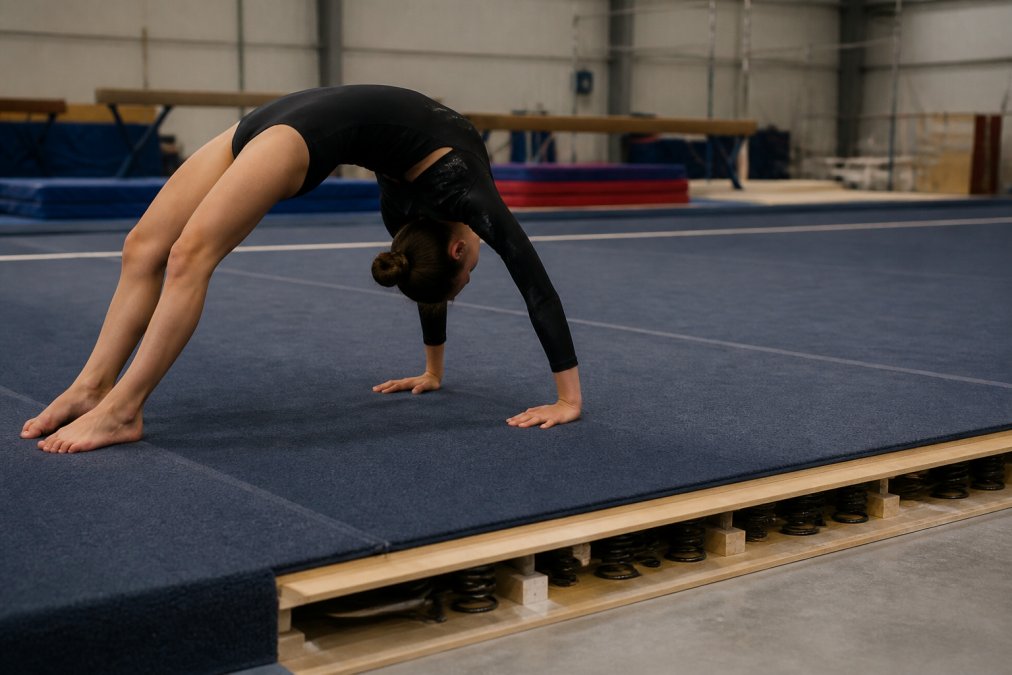
 ultimate-guide
Impact Reduction Standards for Gymnastics Flooring
Table of Contents
- What Impact Reduction Standards for Gymnastics Flooring Actually Require
- ASTM F2772 Standards Explained: Force Reduction and Beyond
- ASTM F1292 Impact Attenuation and How It Is Tested
- Gymnastics Floor Shock Absorption Ratings Compared by Material
- Injury Prevention Through Flooring Design: Safety Benefits for Athletes
- Subfloor Protection, Maintenance, and Compliance for Facility Owners
- Frequently Asked Questions
Last Updated: September 23, 2026
What Impact Reduction Standards for Gymnastics Flooring Actually Require
Impact reduction standards for gymnastics flooring are the testing protocols and performance thresholds that determine whether a surface absorbs landing forces safely enough for repeated training and competition. This guide from Glory and Power Enterprises breaks down what facility managers, coaches, and gym owners need to know before specifying a floor.
The Standards That Govern Competitive Surfaces
ASTM F2772 is the Standard Specification for Fitness Equipment and Fitness Facility Safety Signage and Labels, and its surface-testing provisions apply to gymnastics and cheer environments. ASTM F1292 is the Standard Specification for Impact Attenuation of Surfacing Materials Within the Use Zone of Playground Equipment, and its drop-test methodology is widely adapted for athletic flooring evaluation.
ASTM F2772 Standards Explained: Force Reduction and Beyond
ASTM F2772 sets performance thresholds a gymnastics surface must hit to be considered suitable for competitive use. The standard covers force reduction, surface friction, and ball rebound, each measured under controlled conditions.
Force Reduction vs. Shock Absorption
Force reduction measures how much a surface deflects under impact compared to a rigid concrete reference. Shock absorption describes the broader ability of the system, including the subfloor and springs, to dissipate energy before it reaches the athlete's joints.
| Metric | What It Measures | Why It Matters |
|---|---|---|
| Force reduction | Deflection vs. concrete | Core compliance number |
| Surface friction | Grip underfoot | Prevents slips on landings |
| Ball rebound | Energy returned to athlete | Affects tumbling height |
| Vertical deformation | Depth of compression | Tied to joint stress |
ASTM F1292 Impact Attenuation and How It Is Tested
ASTM F1292 impact attenuation is the drop-test method that measures how a surface decelerates a falling mass, expressed as a g-max value and a Head Injury Criterion score. Lower g-max means gentler deceleration and less force transferred to the athlete.
Gymnastics Floor Shock Absorption Ratings Compared by Material
Gymnastics floor shock absorption ratings vary widely by material and construction, and the differences show up in force reduction percentages, compression set behavior, and energy return. Most buying guides stop at naming material types. This comparison goes further by explaining the mechanism behind each rating band and how each material behaves over a realistic service life.
How Each Material Produces Its Rating
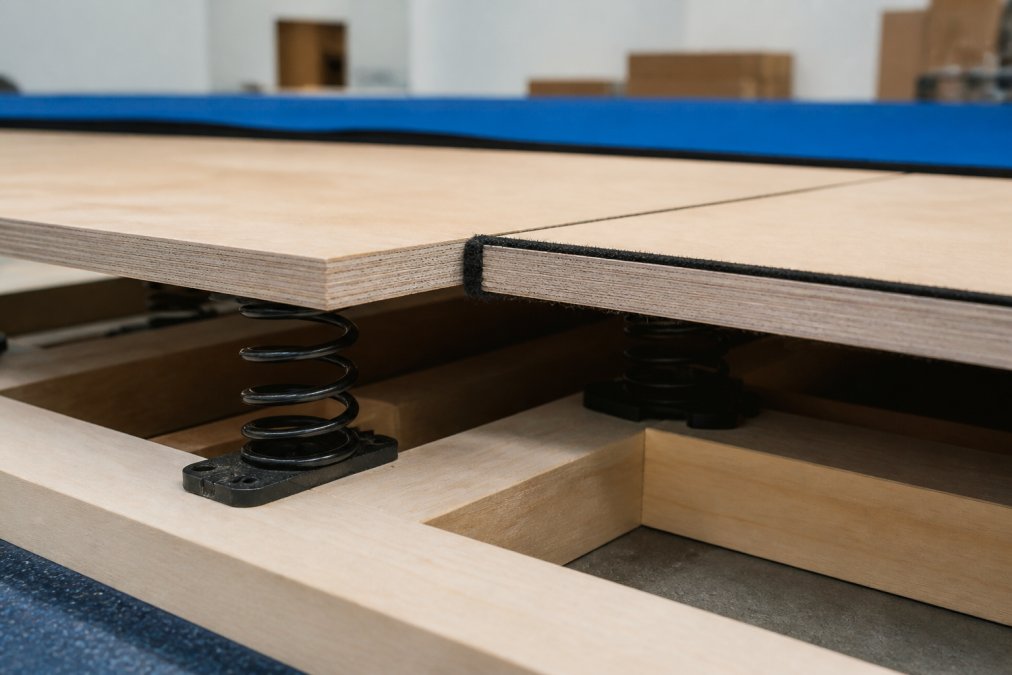
Sprung wood systems. A competition spring floor uses two layers of Baltic birch decking over steel coil springs. The springs compress on impact, the wood deck flexes, and the system returns a portion of the energy to the athlete. Because the springs and deck are tuned together, sprung systems typically produce the highest force reduction values of any construction type, and the energy return supports rebound skills and repeated tumbling.
What Actually Drives the Rating
Material density, tensile strength, and compression set determine how a surface holds its rating after thousands of landings. Two floors made from the same nominal material can test very differently if density or cell structure differs. That is why a supplier's force reduction test report matters more than the material name on a spec sheet.
| Material | Impact Mechanism | Force Reduction Band | Energy Return | Long-Term Behavior |
|---|---|---|---|---|
| Sprung wood over steel springs | Spring compression plus deck flex | Highest | High | Stable if springs and fasteners are maintained |
| Carpet-bonded foam | Foam cell compression | Moderate | Low to moderate | Compression set reduces rating over time |
| Rubber underlayment | Elastic deformation | Moderate to high | Low | Consistent attenuation, limited rebound |
| Foam roll goods | Foam cell compression, no structure | Low | Low | Bottoms out under hard landings |
Matching Material to Use Case
A competition training floor and a low-impact warm-up area do not need the same construction. For high-volume tumbling and dismount landings, a sprung system is the only construction that combines high force reduction with meaningful energy return. For auxiliary spaces, rubber underlayment or foam roll goods can be adequate if the expected landing forces are lower. The right question is not which material is best in the abstract, but which material holds its rating under the specific loads the space will see.
Injury Prevention Through Flooring Design: Safety Benefits for Athletes
Injury prevention through flooring design starts with matching the surface to the sport's landing forces. Gymnasts and cheerleaders absorb forces many times their body weight on dismounts and tumbling passes.
Subfloor Protection, Maintenance, and Compliance for Facility Owners
Subfloor protection is the layer most facility owners overlook, and it is also where a compliant top surface most often fails. Even a floor that passed testing at installation can drift out of compliance if the subfloor flexes, cracks, or traps moisture beneath the springs. This section covers what to protect, how to maintain impact properties over time, and what documentation to keep on file.
Subfloor Protection Requirements
A gymnastics floor system transfers landing forces into the subfloor. If the subfloor deflects, the springs cannot do their job, and the effective force reduction drops. Key requirements:
- Flatness and stability. The subfloor must be level and rigid enough that spring compression is consistent across the entire surface. A floor that varies in g-max from one panel to the next creates unpredictable landings, which is a real injury risk in tumbling passes that cover distance.
- Moisture control. Moisture trapped beneath springs or foam degrades wood decking and foam cells. A vapor barrier and adequate ventilation protect the system from the inside out.
- Anchoring and load distribution. Springs and panels must be anchored so they do not migrate under repeated impact. Fasteners that loosen over time change how the system distributes load.
Maintaining Impact Properties Over Time
Impact reduction ratings are not permanent. Material fatigue affects how a floor performs over a five-to-ten-year horizon, and the rate of decline depends on use volume and material type.
- Springs lose tension and can develop fatigue cracks. Inspect for uneven compression and replace springs in matched sets.
- Foam takes a compression set. The loss is usually gradual and concentrated in high-traffic landing zones, so test those areas first.
- Fasteners loosen. A loose panel changes the load path and can create a hard spot.
- Wood decking can delaminate or crack, especially near seams.
Regulatory Compliance and Liability for Facility Owners
Regulatory compliance for facility owners means keeping test documentation on file and re-testing after major repairs or reconfigurations. Many insurers and sanctioning bodies ask for current impact attenuation records, and a gap in that documentation can affect a claim after an injury.
A defensible compliance file typically includes:
- The original force reduction and impact attenuation test report, naming the testing lab, drop height, and test date
- Re-test records after any repair, move, or reconfiguration
- A maintenance log showing inspections and part replacements
- Manufacturer documentation for the floor system and its rated performance
Comparing Material Types for Long-Term Performance
For owners comparing material types, the trade-off usually comes down to upfront investment versus long-term performance stability:
- Sprung wood systems: highest force reduction, longest service life with proper upkeep
- Carpet-bonded foam: lower upfront cost, faster compression set under heavy use
- Rubber underlayment: consistent attenuation, limited energy return
- Foam roll goods: budget option, best for low-impact training areas
Frequently Asked Questions
What are the ASTM standards for gymnastics floor shock absorption?
ASTM F2772 is the main standard for gymnastics flooring systems. It sets performance thresholds for force reduction, energy restitution, and surface friction, tested with a standardized impact device. ASTM F1292 covers impact attenuation and is used for surfaces where fall height matters. Together they give facility owners measurable criteria instead of guesswork when comparing products.
What is the difference between shock absorption and force reduction?
Shock absorption describes how a surface spreads and damps impact energy over time. Force reduction measures how much peak impact force the floor removes compared to a rigid concrete reference, expressed as a percentage. Force reduction is the number ASTM F2772 tests; shock absorption is the broader behavior behind it. A floor can absorb energy well but still fail force reduction thresholds if it is too stiff.
How does floor thickness affect impact reduction in gymnastics?
Thicker systems generally allow more vertical deformation, which lowers peak forces on joints. But thickness alone does not guarantee compliance. A 2-inch foam layer over concrete can test worse than a thinner sprung system with properly engineered springs and a Baltic birch deck. The interaction of deck, springs, and foam decides the rating, not the thickness number on its own.
Why is force reduction critical for injury prevention in gymnastics?
Landings from tumbling passes and dismounts generate forces several times an athlete's body weight. A surface with adequate force reduction lowers that peak load, which reduces stress on ankles, knees, and the lumbar spine. Floors that test below the ASTM F2772 threshold pass more of that energy into the athlete, raising the risk of overuse injuries and acute joint damage over a season.
How do spring floors meet safety requirements for competitive gymnastics?
Compliant spring floors combine a two-layer Baltic birch deck, steel power springs, and a foam or carpet-bonded top layer. The deck distributes load, the springs provide energy restitution for tumbling, and the top layer tunes force reduction. Manufacturers test samples to ASTM F2772 and provide documentation. Facility managers should keep those test reports on file for insurance and sanctioning bodies.
Do impact properties change over time, and what maintenance keeps them in spec?
Yes. Foam layers compress, springs lose tension, and deck panels can loosen at the seams. Compression set and reduced spring tension both lower force reduction. Annual inspection of spring bolts, fastener tightness, and foam thickness, plus re-testing every few years, keeps the floor within its original ASTM F2772 rating. Replacing worn foam or re-tensioning springs costs far less than a full replacement.
What should facility owners check for regulatory compliance?
Keep the manufacturer's ASTM F2772 test report, installation records, and maintenance log on file. Insurance carriers and sanctioning bodies may request them after an injury claim. Confirm the floor's rated use, since a surface approved for recreational classes may not meet the threshold for competitive tumbling. Document any repairs and re-test after major work.