 blog
Mancino Mats vs VA Surfaces: Which Gym Mat Fits Your Needs
Last Updated: November 4, 2026
Quick Summary
Mancino Mats and VA Surfaces both make gymnastics mat options, but they suit different priorities. Choose by comparing panel count, foam core density, hinge construction and folded size against your room, athletes and budget. Neither brand is a universal winner.
- Thicker foam absorbs more impact, so match thickness to the highest landing height the athlete regularly performs.
- Fewer, larger panels lie flatter, while more panels fold into a tighter footprint for storage.
- The hinge is the first point of failure on a folding mat, so check reinforcement and whether fasteners are replaceable.
- Compare total cost including freight, customization and replacement parts, not just the sticker price.
- Confirm current specifications directly with each manufacturer, since model lines change between production years.
Table of Contents
- How Mancino Mats and VA Surfaces Differ at a Glance
- Gymnastics Mat Thickness: What Each Option Offers
- Gymnastics Mat Sizes and Folding Mat Configurations
- Mancino Folding Mats Compared With VA Surfaces Models
- Warranty, Customization and Support Compared
- Total Cost of Ownership and Facility-Specific Recommendations
- Choosing Between Mancino and VA Surfaces for Your Gym or Home Practice
- Frequently Asked Questions
How Mancino Mats and VA Surfaces Differ at a Glance
Gymnastics gyms and home practice spaces often narrow their choices to two names: Mancino Mats and VA Surfaces. Both make landing and training mats for gymnastics and related disciplines, but the products are built around different priorities. This comparison is meant to help buyers match a mat to their actual training needs, not to declare a single winner.
The short version: buyers who prioritize folding convenience and many configurations will weigh one set of factors, while buyers who need a fixed, high-performance surface for a dedicated facility will weigh another. Matching the product to the room, the athletes and the budget matters more than any headline specification.
Shoppers should compare construction, dimensions, thickness options and warranty terms side by side before ordering. The sections below walk through each of these areas.
Gymnastics Mat Thickness: What Each Option Offers
Thickness is one of the most important specifications when comparing a gymnastics mat. Thicker foam absorbs more impact on landings, which matters for skills performed from height and for younger athletes still learning body control.
Thinner mats are lighter and easier to move, but they provide less cushioning. Thicker mats offer more protection but weigh more and can be harder to fold. For a deeper look at how these floor types compare, see the sprung floor vs foam mats comparison. Buyers should confirm the exact foam core and density for each model rather than relying on general thickness labels, because construction varies between product lines.
Matching Thickness to Skill Level and Landing Height
Beginners and home users often choose a thinner mat for storage and portability. Intermediate and advanced athletes, particularly those performing higher skills, generally need greater thickness for safe landings. A practical rule is to match the mat to the highest landing height the athlete regularly performs, then confirm the surface still meets the space's needs for transport and storage.
Gymnastics Mat Sizes and Folding Mat Configurations
Dimensions determine how much training area a mat provides and whether it fits the room. Common formats include single panels, folding mats and longer tumbling strips.
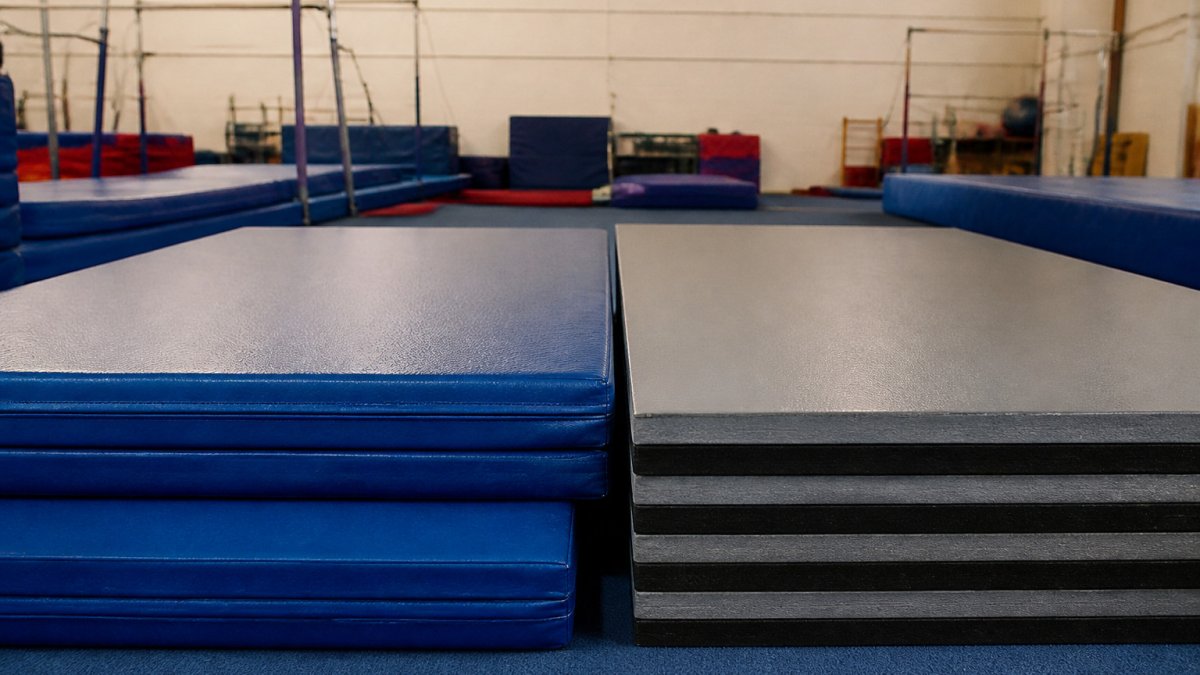
Folding configurations divide the mat into sections that fold for storage. This makes a large surface practical in a small gym or home, but folds can affect how flat the surface lies.
For a home practice setup, a smaller practice landing mat may cover most needs. A facility covering a larger area may prefer a longer folding competition mat.
Mancino Folding Mats Compared With VA Surfaces Models
Most ranking pages describe folding mats in the abstract.
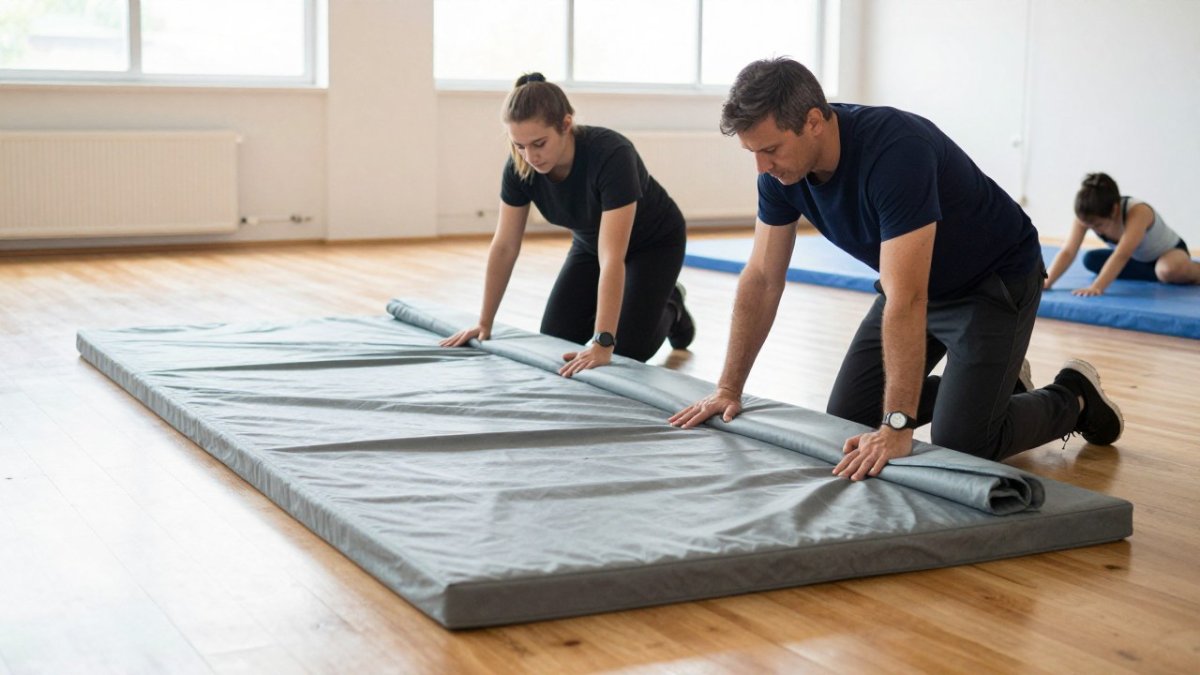
What to compare, and why it matters
- Panel count and section size. A 4-panel mat and a 6-panel mat of the same overall length behave very differently in storage and in use. Fewer, larger panels usually lie flatter and create fewer hinge lines underfoot; more, smaller panels fold into a tighter footprint. Record the number of panels, the length and width of each panel, and the overall mat dimensions for both brands before comparing.
- Foam core and density. Thickness alone is not a specification. Ask for the foam type (for example, polyethylene or polyurethane), the density rating, and whether the core is a single slab or layered. Two mats listed at the same thickness can differ substantially in firmness and rebound depending on the core.
- Cover material and seam construction. Vinyl covers vary in weight and in how seams are joined. Compare cover thickness, whether seams are stitched, heat-sealed, or both, and whether the hinge area is reinforced. The hinge is the first place a folding mat fails, so reinforcement details matter more than the cover color.
- Hinge and fastener design. Check how panels are joined (continuous hinge, straps, or hook-and-loop) and whether the fasteners are replaceable. A mat whose hinge cannot be serviced has a shorter practical service life regardless of foam quality.
- Handles and weight. Confirm handle placement, handle count, and the mat's shipping and working weight. A mat that is too heavy for one person to move will be used less often in a home setting.
- Folded dimensions. The folded footprint, not the open size, determines whether the mat fits a closet, a wall rack, or a vehicle. Get the folded length, width, and height for each model.
- Certifications and testing claims. Ask which standards, if any, the product is tested to and request the documentation. Treat unqualified "meets safety standards" language as a prompt to ask for the specific standard and test report.
How to run the comparison
Build a simple two-column sheet with Mancino on one side and VA Surfaces on the other, and fill in each row from the current product page or a written quote.
Watch out: model lines and panel configurations change between production years, so a specification you find in a review or a reseller listing may not match the current build.
Where the two approaches tend to diverge
In practice, the comparison usually comes down to priorities rather than a clear winner.
The table below lists the specifications to check side by side when comparing the two brands.
| Specification | What to check | Why it matters |
|---|---|---|
| Panel count and section size | Number of panels and each panel's dimensions | Fewer, larger panels lie flatter; more panels fold smaller |
| Foam core and density | Foam type, density rating, single slab or layers | Same thickness can feel very different in firmness |
| Cover material and seams | Cover thickness, stitched or heat-sealed seams | Affects durability and hinge-area wear |
| Hinge and fastener design | Continuous hinge, straps or hook-and-loop; replaceable parts | Hinges are the first point of failure on folding mats |
| Handles and weight | Handle count and placement, shipping and working weight | Determines whether one person can move the mat |
| Folded dimensions | Folded length, width and height | Decides whether the mat fits a closet, rack or vehicle |
| Certifications and testing | Named standard and test report | Unqualified safety claims need documentation |
Warranty, Customization and Support Compared
Warranty coverage and customization options often separate suppliers more than the base product does. Before purchase, confirm the warranty period, what it covers (foam, cover, seams or folding hardware), and how claims are handled. Ask whether custom sizes, colors or logos are available and what lead time to expect.
Support matters most after delivery. Buyers should check how quickly a supplier responds to questions, whether replacement parts are available, and whether the company offers guidance on installation and maintenance. Buyers should confirm current terms directly with the supplier.
Total Cost of Ownership and Facility-Specific Recommendations
Purchase price is the smallest part of what a mat costs over its life. Our guide to buying professional gymnastics floors online walks through the practical steps before you order.
The five cost components to model
- Acquisition cost. The quoted price for the mat as configured, including any custom size, color, or logo work. Customization almost always adds cost and lead time, so price the standard configuration first and treat customization as a separate line.
- Freight and delivery. Large folding mats ship by freight, not parcel. Confirm whether the quote is delivered or ex-works, whether liftgate and inside delivery are included, and whether residential delivery carries a surcharge. Freight can be a meaningful share of a single-mat order and shrinks as a percentage on multi-mat orders.
- Installation and setup. Most folding mats need no installation, but fixed landing surfaces and mat systems that integrate with a spring floor do. Budget for labor if the mat is part of a larger floor build.
- Maintenance and repair. Vinyl covers are cleaned with mild soap and water; the real cost is hinge and seam repair. Ask whether replacement hinges, cover patches, or replacement panels are sold separately, because a mat with serviceable parts outlives one that must be replaced whole.
- Replacement frequency. Divide the acquisition cost by the expected service life to get an annualized cost. A mat used daily in a club will wear faster than the same mat used twice a week at home, so the same product can have very different annualized costs by setting.
A worked way to compare, without guessing prices
Because pricing depends on dimensions, quantity, configuration, and delivery location, request a written quote from each manufacturer for the same specification: same length, width, thickness, panel count, and cover.
Facility-specific recommendations
- Home practice. Prioritize a mat one person can move and store: fewer panels, lighter weight, a folded footprint that fits a closet or against a wall. A compact practice landing mat covers most home needs; a full competition-size mat is usually overkill and harder to store.
- School or multi-use space. Prioritize durability and fast setup and teardown. Look for reinforced hinges, replaceable fasteners, and a cover that tolerates frequent cleaning. Multiple smaller mats often beat one large mat because they can be reconfigured for different classes.
- Dedicated gymnastics club. Prioritize a fixed or semi-fixed surface that handles daily use and higher landing heights. Thicker cores, heavier covers, and documented testing justify the higher upfront cost because the mat is in constant use.
- Cheer or martial arts program. Prioritize surface consistency and portability between practice spaces. Confirm the mat lies flat after repeated folding, since a mat that develops hinge ridges affects landings and drills.
Where the decision usually goes wrong
Watch out: buyers often compare quotes at different specifications, then treat the lower number as the better value.
For facilities planning a full floor build, layout planning matters as much as the mat itself. A CAD gym design service can help you plan the layout and flooring before you commit to a purchase.
Choosing Between Mancino and VA Surfaces for Your Gym or Home Practice
The right choice depends on the room, the athletes and the budget. Start by listing the training area, the highest landing height, how often the mat will be moved, and the storage space available. Then compare thickness, dimensions, folding design, warranty and support against those answers.
Glory and Power Enterprises manufactures competition spring floors and sprung dance floors for cheerleading, gymnastics, martial arts and dance. For current specifications and a quote, visit the company website.
Frequently Asked Questions
What are the best gymnastics mats for training?
The best gymnastics mat depends on the skill being trained, the thickness needed for landing height, and how often the mat must be moved. Compare Mancino folding mats and VA Surfaces models on thickness, folding design, cover durability and warranty terms, then match the thickness to the skills your athletes perform most. Request current specifications and a quote directly from each manufacturer, since pricing varies by size, quantity and delivery location.
What thickness should a gymnastics mat be?
Thickness should match the height and impact of the skills performed. Beginners learning rolls and basic tumbling often train well on thinner, firmer mats, while athletes doing higher landings benefit from thicker foam cores that absorb more impact. Confirm the exact thickness of any model you are considering from the manufacturer's specification sheet before ordering, because thickness is a key factor in both safety and performance.
What are the common sizes of gymnastics mats?
Gymnastics mats are commonly sold in standard lengths and widths that let them be joined or folded for storage, and many are built as panels or sections. Folding designs make it easier to store and move a mat in a home or school setting. Check the listed dimensions, folded size and weight for each model, since these determine whether a mat fits your training area and whether one person can handle it.
How do you choose a mat for home gymnastics practice?
For home practice, prioritize a mat that folds or stores easily, has enough thickness for the skills you train, and a vinyl cover that resists wear. Measure the room first so the mat leaves safe clearance around it. Ask the manufacturer about warranty coverage and whether custom sizing is available. Glory and Power Enterprises can provide current product details and a quote through its website.